The ICE Men Cometh
Fear and emotional fragility are not reasons to stay home.
By Laura Esther Wolfson
I know little about the legalities and bureaucratic intricacies of immigration; my grandparents took care of all that long ago at Ellis Island, so that my parents and succeeding generations wouldn’t have to. But really all anyone needs to know right now is that the Trump administration is targeting and rounding up members of a vulnerable minority, and betting that few people will notice or care. The world has seen this before.
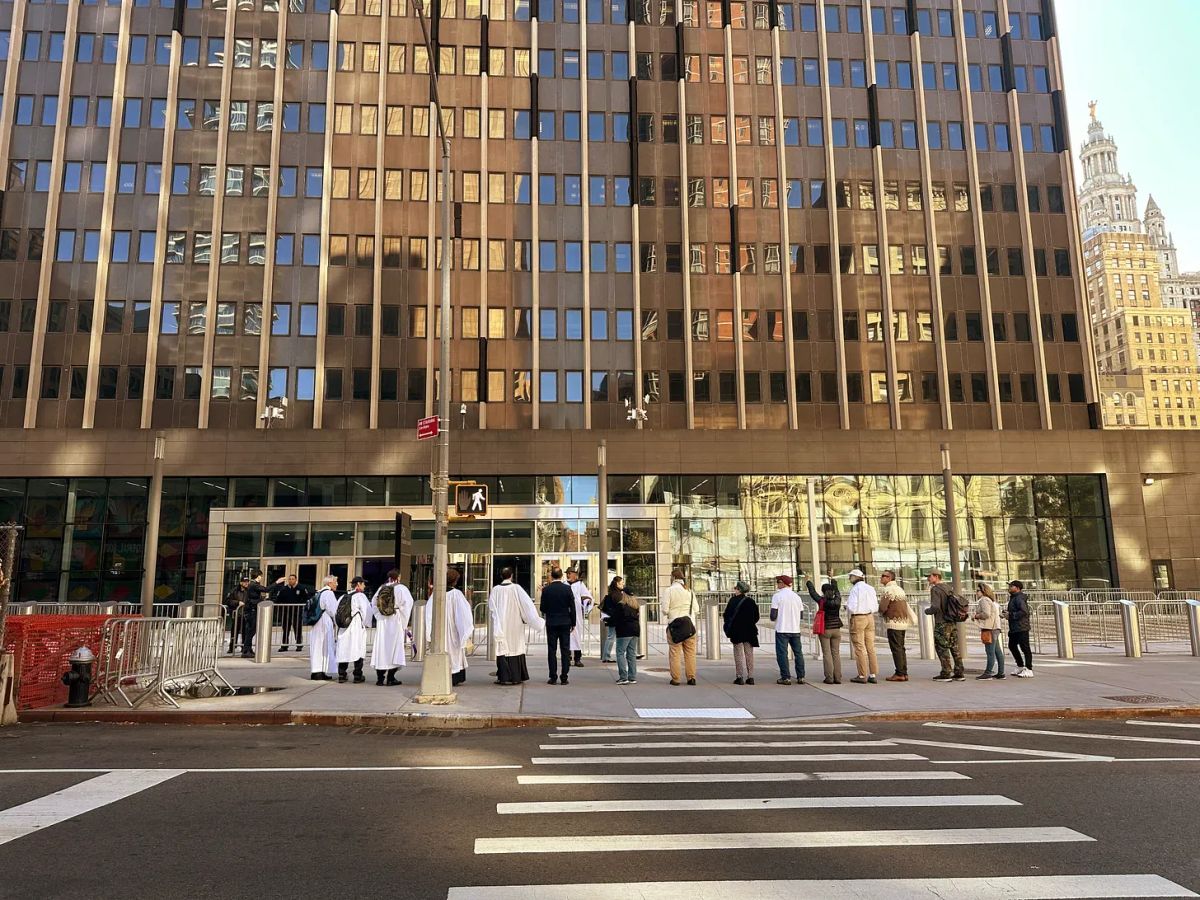
Soon after the National Guard went into Los Angeles in June, an informal group of a few hundred activist volunteers began attending immigration court in downtown Manhattan in shifts, adding their efforts to those of a smaller group of veteran observers who have been going to immigration court for years. We provide immigrants with whatever aid and support we can -- I must pass over in silence precisely what some of that aid and support consist of -- prioritizing de-escalation and safety, as they run the ICE gauntlet before and after their hearings.
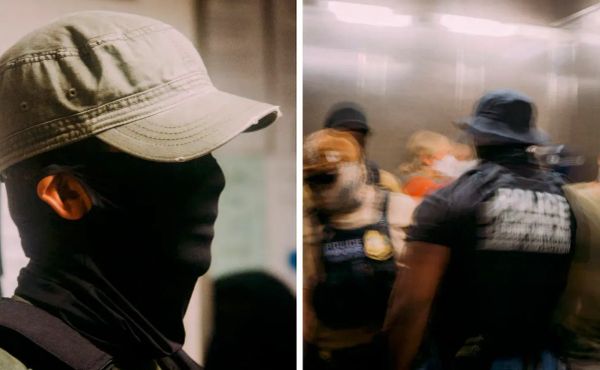
And it is indeed a gauntlet; right after I arrived on my first day, I saw a throng of burly men, masked in Spandex from cheekbone to clavicle, surround a man and hustle him onto an elevator, as nearby, a woman sagged against the wall, crying out, “Es mi hermano!” [He’s my brother!] over and over.
When someone is going through one of the very worst experiences they will ever have, there’s little you can say that doesn’t feel callous. When I addressed the woman in my halting—but as of this writing rapidly improving—Spanish, she turned away. Perhaps she thought I was part of the carceral apparatus.

What the hell am I doing here? I asked myself. How can I possibly help the people being seized by these armed men in masks?
I briefly considered leaving and not coming back. The urge to turn away is strong, as you go about your life—working, getting groceries, strolling in the park, running for the bus, all the things we do in the course of an ordinary week in an ordinary life— to imagine that these atrocities aren’t happening right here, right now.
I saw a married couple torn apart that same afternoon. They’d come to the US together—same point of entry, same status and legal procedures, same case. The lawyer for the Department of Homeland Security made a motion to separate their cases, and the judge obliged. The more experienced observer seated next to me in the back row passed me a note: Not a good sign.
In the hallway outside the courtroom, the masked men poured off the elevator, massing ominously. Clearly, they’d been summoned.
The husband conferred with an observer before leaving the courtroom, which was, at that time, an inviolable space; like vampires who cannot enter a church, the masked men didn’t cross the threshold. This allowed judges to claim ignorance of what was playing out in the hallway a few feet away from where they sit on their benches way up high, to say that they had no control there, were responsible only for what happened within the boundaries of their tightly circumscribed domain. Recently, however, the directive must have changed, for now the vampires do sometimes breach the threshold and enter the courtrooms, without, as in the movies, being reduced to ash.
Several of us encircled the man as he stepped out into the hallway, linking arms with him and each other. The masked men walked toward us; we walked toward them; we came toe to toe. A scuffle ensued. They tossed a few of us against the wall, and cursing, they handcuffed the husband and led him away.
His wife gasped, sank into a chair, and put her head between her knees. A few woman observers sat with her, held her hand, brought water.
On my next visit, I saw another couple sundered. The husband appeared alone, explaining that his wife, a US citizen, was at home with their disabled child.
“Please don’t dismiss my case,” he implored. “I followed the rules. I didn’t say I was persecuted in my country. I told the truth: I couldn’t stand being away from my wife. My family needs me. I’m their sole support.”
The judge granted him a 2026 court date, and the man looked relieved. He stepped into the hallway and was grabbed.
“The judge just set his next court date for next year,” I called out as he was led away. “You can’t take him!”
Without a word, they disappeared into the stairwell with the man and clanged the door shut behind them. They gave no answer because we the people are not the ones they answer to; they have daily quotas, and immigration court is where they can meet them most efficiently. The immigrants they gather up there by the armload have come to the courthouse precisely because they’re following the rules, but such niceties have now gone out the window.
On a different day, I spoke with two young West African men in the waiting room. (My French is better than my Spanish.) When the first one came out after his hearing, he immediately grasped what awaited and saw that there was no way out. He waved away our offers of help, squared his shoulders and walked straight into the arms of the masked men.
Soon the other man came out.
“Où est mon ami?” he asked softly. [Where’s my friend?]
I took a deep breath.
“ICE l’a pris,” I said. [ICE took him.] “Je suis désolée.” [I’m so sorry.]
“Ça veut dire qu’ils vont me prendre aussi.” he said, disbelieving, almost dreamy. [That means they’re going to take me too.]
“Oui—oui. J’ai peur pour vous...” [Yes—yes. I’m afraid for you...]
There was nothing else to say. I squeezed his hand, and then he was gone.
I went to the restroom to collect myself. As I was drying my hands, a woman came in.
“Your family and friends aren’t being taken,” she said in excellent English with a slight Spanish accent, “but you come and help us anyway.” She hugged me.
“Thank you, sister!” she said.
At some point—the days, full of hearings and abductions, are starting to run together—I escorted a woman out of the building to the train. (The masked men displayed not a flicker of interest; this was back when they were taking only men.)
“Cómo se dice en inglés [How do you say in English] ‘dios es bueno’?” she asked.
“God is good,” I translated for her.
“God—is—good!” she repeated slowly, working to master the words. She hugged me and said it again, with feeling.
“Dios es bueno,” I echoed, still in her embrace. I’m not a believer, but it was what the moment called for.
What I’ve recorded here is a mere sampling of what I’ve seen since mid-June, but even if I’d seen no more than this, it would be obvious to me, an ordinary citizen, that we’re in a historic moment of moral clarity.
City council members have visited immigration court; officials from the city’s executive branch have visited; state assembly members have visited. They remonstrate with the masked men and speak indignantly to the press, but, like us, they’re powerless; the masked men have a monopoly on force.
The only way to put an end to the ICE abductions would be to meet them with greater force, which would, by definition, entail a military coup. No one has suggested this. All we court watchers can do is bear witness.
The courts are open to the public, for now at least. Almost any able-bodied person can do this work; the hours are flexible, no equipment or experience needed, foreign languages helpful but not required. (We are all volunteers, as I noted earlier; we are not remunerated. George Soros is not involved in any way, despite what you may have seen on social media.) Fear and emotional fragility are not reasons to stay home—no one is tough enough to do this work, including those who do it, and those who do it are also afraid. All the same, it must be done.
I think of abolitionists in the days of slavery, secretly ferrying fugitives northward to relative freedom. I think of the righteous gentiles, hiding Jews in their attics and basements. Did they lament, as we do, that they could not do more—save more people, end slavery, put an end to genocide?
I look the masked men in the eye—not difficult; it’s the only part of them you can see—and I ask myself: have we Americans—goons and non-goons alike—learned nothing from those famous atrocities, which we hear so much about and about which we know so little?
And what ever happened to “Give me your tired, your poor, your huddled masses yearning to be free…”? There is, in fact, a rapidly expanding class of huddled masses—made-in-America huddled masses. This land may be my land, and it may be your land, but it isn’t their land; they’re being jammed into lockups from California to the New York island.
Laura Esther Wolfson is the author of For Single Mothers Working As Train Conductors (University of Iowa Press, 2018) and the forthcoming Just Writing This is Killing Me (Regal House Publishing, 2027). She’s a climate justice activist, teacher of formerly incarcerated people, immigrant advocate, and UN translator (retired). (Spanish is not one of her working languages.) For more, see lauraestherwolfson.com