The Book of Law
That day I witnessed different realities on two sides of the courtroom door.
By Wanda Siedlecka
I try not to think about the place I am heading. It’s easy when I am going there early in the morning. I am half asleep anyway. I suppress the feeling of dread that Immigration Court evokes and let my thoughts drift away like wisps of smoke, unsure if they are in English or Polish. Most likely mixed. I came to this country forty-four years ago, at the age of thirty-four. Today, I’m a particle in the mass of people pouring through the streets, through the entrances to subway stations and office buildings. We think about the coffee we will soon have, the stuff posted on social media, meetings, phone calls, what’s for dinner. We flow like a river towards a waterfall, towards a future in which corporate moguls make us work and then take every penny back when we buy from them what they decide we “want.”
On the subway, a short, stocky woman with long black hair begins preaching. She says the usual: Jesus died for us on the cross, nails pierced his hands and feet, he suffered so that we might be saved, and now we abandon him, rendering his sacrifice useless—we sinners, indifferent, lost in our own little world. “Wake up,” she raises her voice, “wake up before it’s too late.” She switches to Spanish, but her compatriots riding the subway woke up very early, not because of spiritual calling but because they needed to go to work in some far away place. They are trying to get a little rest before a long day, or perhaps after a long night. Her voice irritates me. I don’t like it when someone scares me with visions of hell, but isn’t that essentially the same as me thinking that everyone is absorbed in some nonsense? Don’t I cry inside and beg the fellow subway riders to wake up? “Listen,” I want to say, “people are being grabbed by ICE agents at the Immigration Court. Some of these people will never again see those they love, but only those who hate them.”
When I get off at Borough Hall, I hear a boombox. The sound must be exploding the ears of passersby. I shake my head disapprovingly. Then I see a Black man parading across Federal Plaza pushing a loudspeaker on a cart, and I realize that it rumbles one word repeatedly —”America.” Ha, we are on the same page, kind of.
America, America, hear me out.
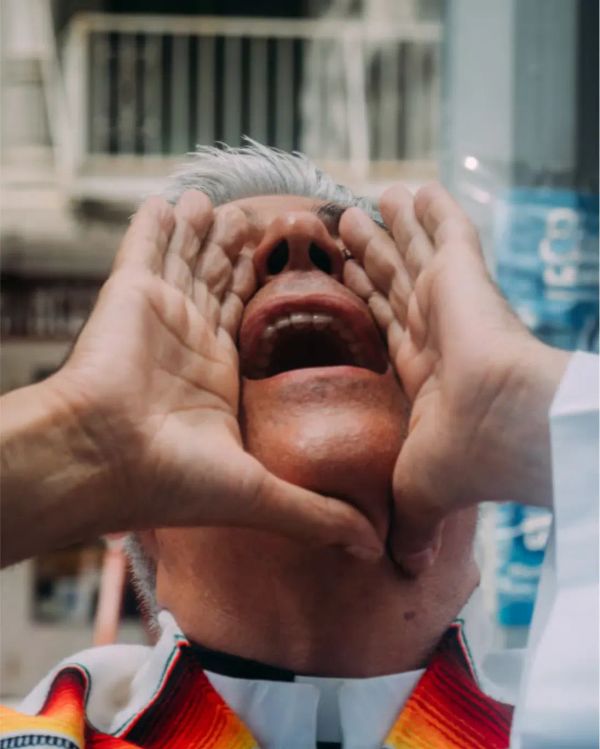
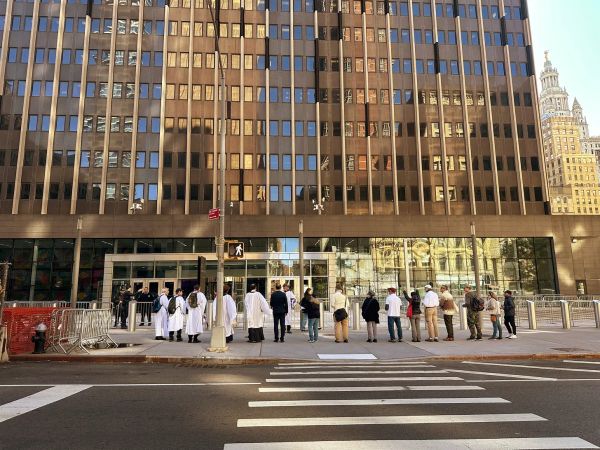
When I get near the entrance to the Immigration Court, I see a group of elders. They gather there driven by some inner voice telling them to get up, get dressed, and go to protect the weak. Later, I hear the security guard referring to the group as “the Jewish people.” My folks were abducted and perished in 1942 in the German occupied city of Lviv, so perhaps I hear the same voice as those elders, but I volunteer not for the Jewish, but for a Latin American charity organization.
I am not ready to go inside yet. I wait for my friend Shifra. Not trusting my abilities, I prefer to follow Shifra around and assist in whatever she does. When ICE agents show up and move from floor to floor, things can get tense, and one needs to react quickly. I feel I am too old, I can’t. I see Shifra walking toward me, smiling. She’s been blessed with a sunny smile. I stop worrying about what I’ll do inside the court if something goes wrong.
In a court waiting room, Shifra checks who among the asylum seekers has a lawyer and who doesn’t. A young lawyer is sitting among them. I listen to the lawyer’s story: how he came to this country as an eleven-year-old with his parents, and how, at eighteen, he went through his parents’ and his own asylum proceedings. He describes how tricky their case was, how nerve wracking, but also his surprising realization that the lawyer who got them through the ordeal followed the rules, which were actually rather clear. “Something,” he said, “I, myself, could do.” He added, “And here I am, years later.”
The young lawyer understood that the book of law is for everyone to see. Anybody can open it, go through the pages, and read as many times as needed the relevant passages. This can help one foresee outcomes, the good and the bad.
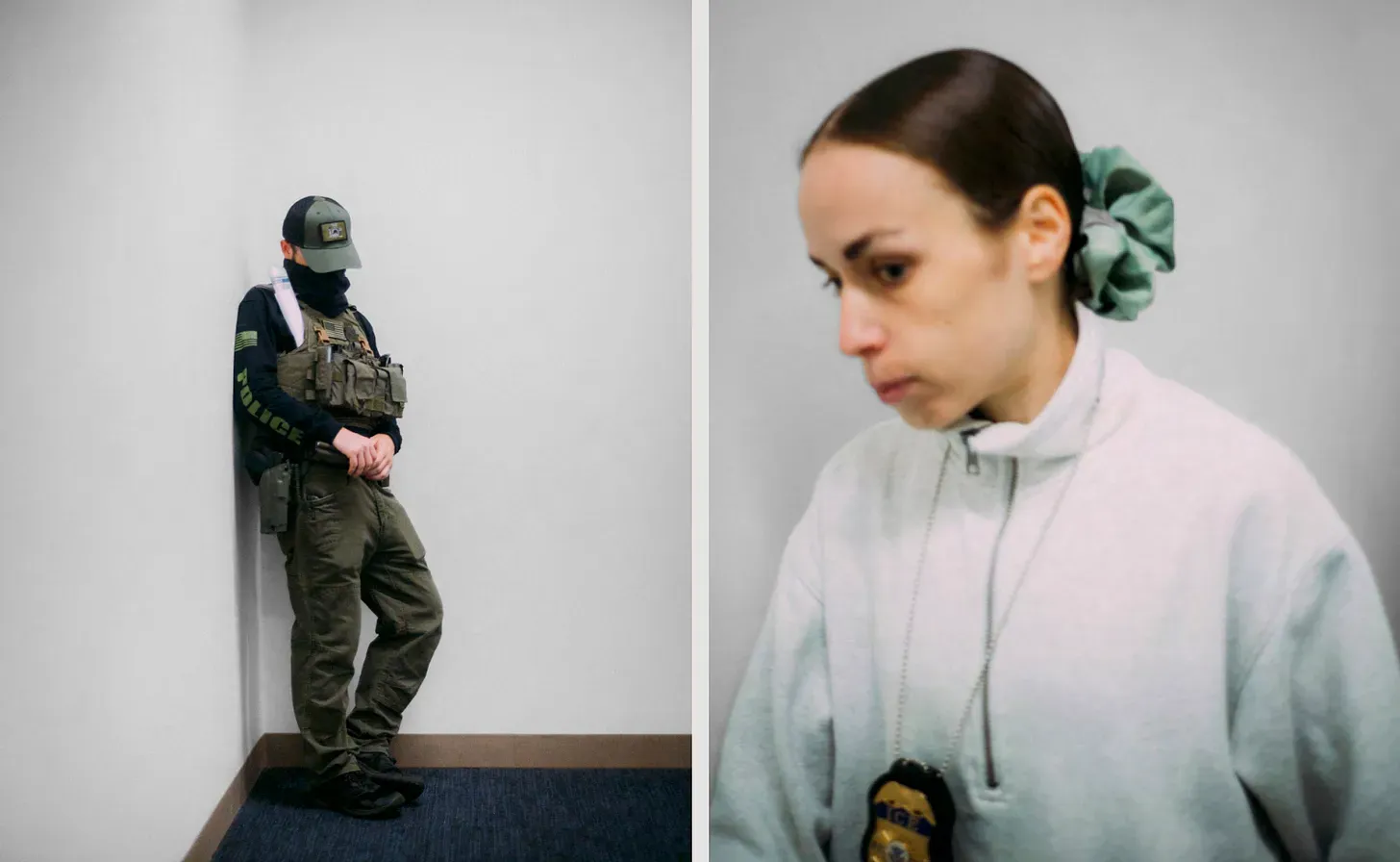
Then I understand why the petite woman in a gray shirt, the ICE manager, who shows up outside the courtrooms surrounded by the “boys,” looks so scary. The list of people to be detained that she clutches in her hand is secret. No one can guess who is on it or why.
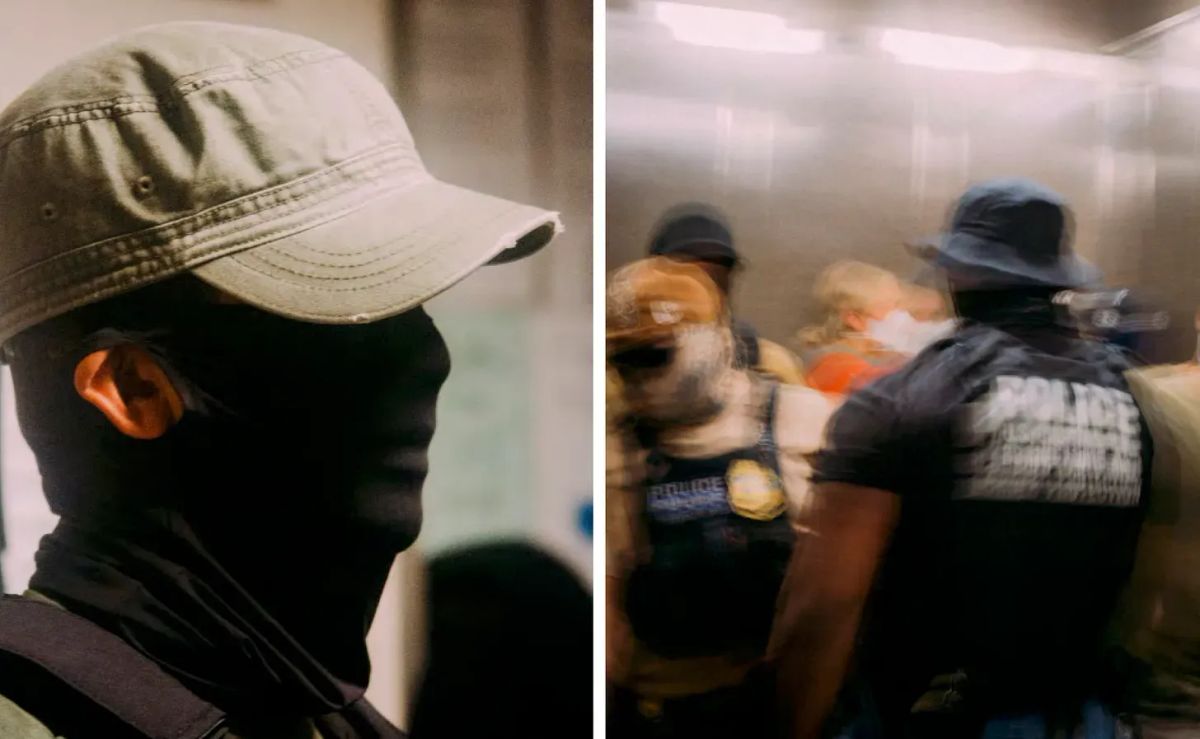
The ICE “boys” wear absurd outfits that blur the line between a recognizable uniform and an arbitrary ensemble. Their sartorial inconsistencies only serve – again – to breed fear. Anything goes: the look of a hunter, an executioner, a secret agent, a militia man. Clothing and accessories that could be purchased at any store and combined as desired. It’s as if grown men were being encouraged to play masquerade – “have fun, boys.” In the end, they look like they were hired by the sanitation department – they are here to clean, to pick up trash and discard.
A volunteer asks me if I’ve witnessed abductions. Yes, I saw one. I followed a man out of the courtroom and saw ICE agents standing in pairs along the hallway. Two grabbed the man and pushed him toward the next two, and then two more grabbed him and pushed him further. It happened quickly, as if some large animal was swallowing this man, and I watched him slide down the long throat. He was wearing a white T-shirt, which my eyes easily followed through the row of men in black. I was struck by how passive his body seemed as he was shoved down the hallway. It lasted only a few seconds, but my memory keeps replaying it in slow motion.
That day I witnessed different realities on two sides of the courtroom door. Inside, the book of law was open for all to read. Outside there were printouts in an ICE manager’s hand—a secret list meant to breed fear.
In the immigration court, instinctual vibes replace verbal communication.
You read the body language and quickly interpret it.
When I walk by a property fence guarded by dogs, I instinctively cross to the other side of the street. Even though the dogs are behind the fence, they seem too eager in their guarding. Just as I don’t look at the dogs behind the fence, I don’t look at the ICE agents waiting in the hallway for people to leave the courtroom. “They won’t jump the fence to hurt me,” I tell myself, but still, I feel uneasy.
A masked man gives me an irritated look from behind the fenceless fence. It’s there. Clearly. My skin is paper-white, and I’m large, unlike a mother of two from Guatemala, who wears an electronic ankle bracelet as if she were a bird. The fence is all air: who stays on which side might be easily changed.